
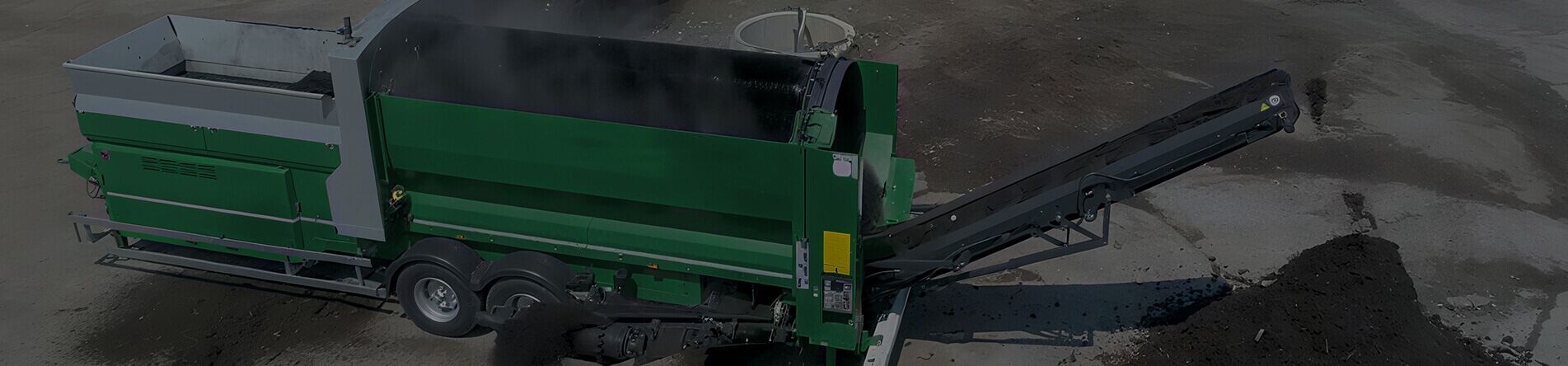
Short answer: peanut kernels and peanut shells leave the sheller inside the same size band, so a size-based screen cannot tell them apart. This machine adds a second separation principle: an 800 × 2000 mm drum screen cleans the feed and sets the particle window, then an adjustable winnowing fan lifts the light, fibrous shells away while the denser kernels drop through. Two clean streams, one pass, up to 20 m³/h, on a fully towable chassis of max. 1,100 kg.

A trommel screen sorts by aperture: anything smaller than the hole falls through, anything larger travels to the discharge end. That logic collapses the moment both of your products sit in the same size range — whole and broken kernels and shell fragments pass the same openings and come out mixed on both sides. Three material behaviours make it worse:
Add seasonal moisture, dust in dry weather, and the need to move the unit between a storage yard and field-edge sites, and a standard catalogue model no longer answers the brief.

Material is loaded through a hinged feed hopper whose folding design widens the loading aperture, so a small loader can charge the machine quickly. Inside the 800 mm diameter × 2000 mm long drum, spiral blades lift and convey the material across a 5 m² screening surface. This stage does three jobs at once: fine dust and broken shell powder fall out early, oversize material such as stones, stalk pieces and unthreshed pods is carried away to the oversize discharge, and stage two receives a reasonably uniform kernel-and-shell mix.
After the drum, material enters an enclosed air chamber fed by an adjustable fan. Air is the second separating principle: a controlled airstream lifts the light, flat, high-drag shell fragments into the shell outlet, while the denser, rounder kernels keep enough momentum to fall through the air column into the kernel chute. Because the cut point between “carried away” and “drops through” depends on variety, moisture and the broken-shell ratio, the fan is fitted with an air damper the operator can adjust. Varieties change from season to season; the machine does not have to be re-engineered for each one.

Custom screening projects rarely fail in the workshop — they fail in the brief. Six answers settle most of the design:
| What we need to know | Why it changes the design |
|---|---|
| What the material is | Peanut shells mixed with whole and broken kernels is not a mineral or compost feed. Both products occupy one size band, which rules out size-only separation from the start. |
| How many output streams you need | Two clean streams — kernels and shells — instead of one mixed pile means two discharge points and a genuine second separation stage. |
| How the material behaves | Light, bulky, airborne shells beside dense, fragile kernels point to air separation plus a low-lift drum, not to high-agitation screening. |
| Throughput target | Decides whether the WTS0820 at up to 20 m³/h is sufficient or the same concept needs a larger frame (WTS1022 / WTS1230 / WTS1550). |
| Power available on site | 2.2 kW of total drive power runs from a small generator or an ordinary site supply, with no heavy electrical works. |
| Dust and working conditions | Dry shell handling generates fine dust and one unit may serve several yards, so the air chamber is enclosed with a dust hood and the chassis stays towable. |
| Parameter | WTS0820 for peanut separation |
|---|---|
| Drum diameter | 800 mm |
| Drum length | 2000 mm |
| Screening surface | 5 m² |
| Throughput | up to 20 m³/h |
| Total drive power | 2.2 kW |
| Machine weight | max. 1,100 kg |
| Mobility | Towable frame with traction device and swivel wheels |
| Screen media | Customisable mesh aperture, set to this material’s kernel / shell split |
| Air separation | Winnowing fan with adjustable damper — the project-specific addition |
| Discharge | Kernel chute plus a separate shell outlet with dust hood |
| Internal drum | Low-lift spiral blades to limit kernel breakage |
| Options | Side conveyor for stockpiling |
| Model | Drum size | Drive power |
|---|---|---|
| WTS1022 | 1000 × 2200 mm | 8.2 kW |
| WTS1230 | 1200 × 3000 mm | 10.6 kW |
| WTS1550 | 1500 × 5000 mm | 20 kW |
The second stream is usually where the business case lives. A clean shell fraction can be sold or reused instead of being paid for as mixed residue — and the same machine that cleans the kernels is what produces it.

Not by size alone. When kernels and shell fragments occupy the same size band, the apertures pass both. A drum screen is used here as the first stage — removing dust, fines and oversize and evening out the feed — and the actual kernel / shell split is made by density in a winnowing chamber.
Because the two products overlap in size. A finer aperture does not discriminate between them; it only reduces open area, plugs faster with fibrous shell fragments and raises the risk of carrying kernels away with the oversize.
The split is made by airflow rather than by beating material against a screen, and the drum is fitted with low-lift spiral blades for gentle conveying. That keeps kernel breakage low compared with high-agitation or vibrating screening.
The WTS0820 is rated at up to 20 m³/h on a 5 m² screening surface. Real output depends on the material mix, moisture and the separation quality you are aiming for. Where a higher throughput is required, the same two-stage concept scales to the WTS1022, WTS1230 or WTS1550.
Yes. Mesh aperture is selected for your kernel / shell split, and the air damper lets the operator move the cut point as variety, moisture and broken-shell ratio change through the season.
Yes. At max. 1,100 kg on a towable frame with a traction device and swivel wheels, one unit can work at the field edge, in a storage yard or inside a warehouse, moved by a single tow.
Total drive power is 2.2 kW driven by a motor and reducer on the carrier rollers, so a small generator or an ordinary site supply is sufficient — no heavy electrical installation.
Biomass fuel, animal bedding, feed filler, growing media and soil conditioner are the common outlets, and the clean fraction can also be sold on as feedstock rather than handled as waste.

Every custom screening project starts from the material itself, not from the catalogue. Three pieces of information are enough for our engineers to come back with a recommended model, mesh specification, airflow setting and quotation:
Every machine is backed by our comprehensive warranty, lifetime online technical guidance, and worldwide spare parts ready to ship.


